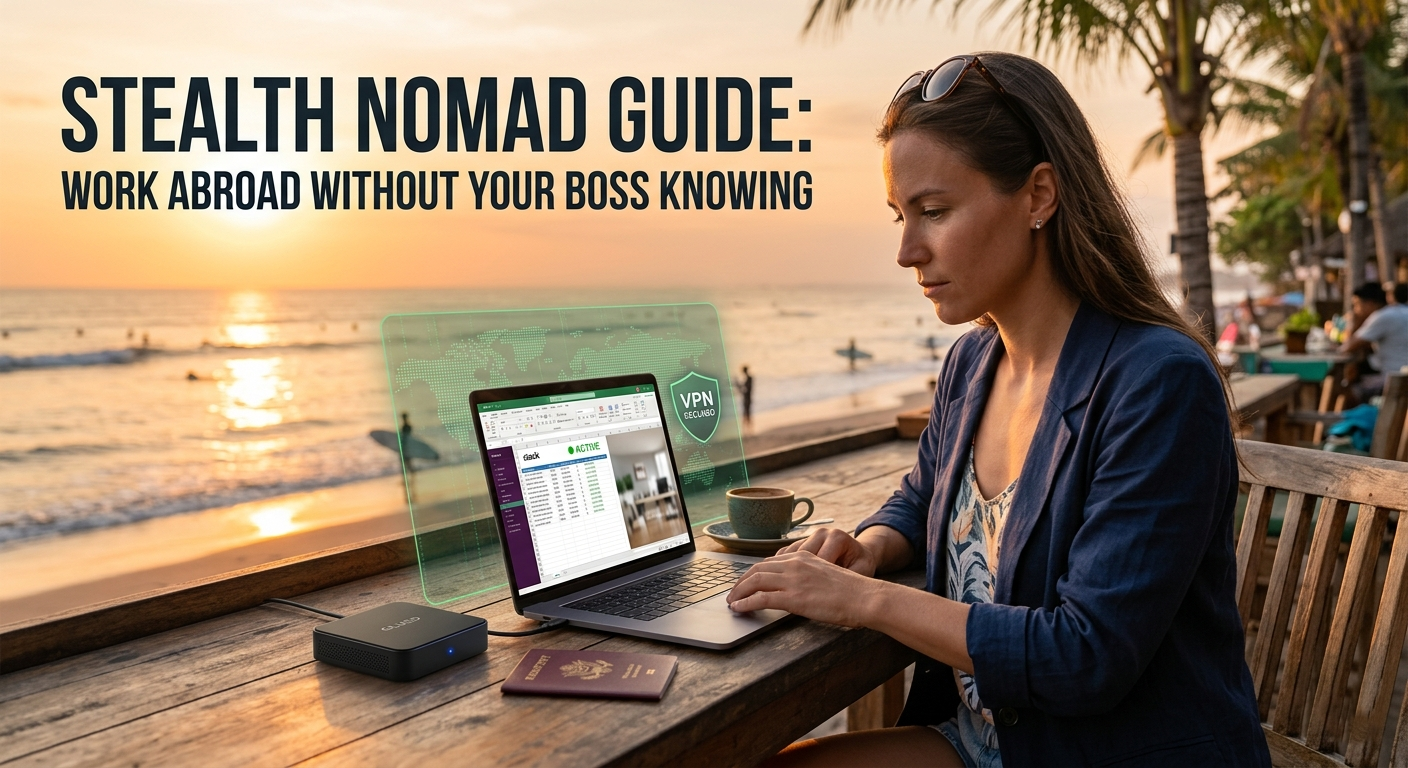
The Stealth Nomad Guide: Work Abroad Secretly
Somewhere right now, a person is answering Slack messages from a café terrace in Tbilisi while their employer believes they’re sitting in a home office in Ohio. Their work is getting done. Their meetings are covered. Their output is, if anything, better than it was six months ago.
They’re what the remote work underground has started calling a stealth nomad: someone who works remotely from abroad without their company’s explicit knowledge or approval.
It’s more common than you think. And it’s more complicated than it looks. Before you quietly reroute your laptop to a different continent, there are things you genuinely need to know, about logistics, legality, and what happens if it unravels. This guide covers all of it.
Why So Many Remote Workers Are Doing This Quietly
Here’s the uncomfortable truth that most corporate remote work policies haven’t caught up to: millions of people have jobs that can be done from literally anywhere, but their contracts say they have to stay within a specific country, sometimes a specific city.
The mismatch between what’s technically possible and what’s contractually permitted has created a quiet rebellion. Workers who spent years commuting to offices, then discovered they could do the same job productively from their living room, are now asking the obvious next question: if location doesn’t matter, why does it matter which location?
According to MBO Partners’ State of Independence report, millions of Americans alone work remotely from international locations, many without formal employer authorization. They’re not all freelancers. A significant chunk are full-time employees, navigating a gap in their company’s policy with varying degrees of awareness about the risks involved.
This isn’t just a lifestyle choice. For many people, it’s a financial decision. A remote salary earned in USD or GBP stretches dramatically further in Southeast Asia, Eastern Europe, or Latin America. The math is hard to ignore.
The Real Risks of Being a Stealth Nomad
Let’s be honest before we get tactical. Working abroad without telling your employer isn’t a consequence-free choice. Understanding what’s actually at stake is the responsible starting point.
Tax and Legal Exposure
This is the big one. If you spend enough time in a foreign country, usually 90 to 183 days, depending on the country, you can trigger tax residency in that jurisdiction. That means your employer could theoretically be liable for payroll taxes in a country where they’re not set up to operate. If it surfaces, the consequences don’t usually fall on you alone. Your employer inherits a compliance problem they didn’t sign up for.
Some countries are more relaxed about this than others. But “relaxed” doesn’t mean zero risk, it means lower probability of enforcement, which isn’t the same thing.
Employment Contract Violations
Most employment contracts include clauses about your primary place of work. If yours does, working from a different country without disclosure is technically a breach. Whether a company would terminate someone over it depends enormously on the employer, the circumstances, and whether it came to light quietly or badly.
Data Security and VPN Considerations
Some employers monitor IP addresses or have IT policies that flag logins from foreign countries. A VPN can mask your location, but it can also raise red flags if your company monitors network traffic. Some corporate security tools actively block VPN usage. It’s worth knowing what your employer’s IT environment looks like before you assume you can disappear into a different timezone undetected.
The Stress Factor
There’s a cost that doesn’t show up in any legal analysis: the constant low-level anxiety of managing a secret. Some people handle it with ease. Others find it exhausting to maintain a version of their life that doesn’t match their reality. That psychological weight is real, and it’s worth factoring in.
Who the Stealth Nomad Life Actually Works For
Not everyone is an equally good candidate for this. Honest self-assessment matters here.
It tends to work best for people who:
- Have strong output metrics — if your performance is measured by results rather than hours logged, there’s less operational friction in being somewhere else
- Work primarily async — roles heavy on real-time collaboration and in-person expectations are harder to maintain across time zones without raising questions
- Have minimal employer IT oversight — the more your company monitors devices, networks, and logins, the harder stealth nomading becomes
- Are in a short-term window — a three-month stretch abroad carries very different legal and logistical risk than a permanent relocation you’re hiding indefinitely
- Have contingency plans — people who’ve thought about what happens if it surfaces, and have an honest answer for that scenario, are in a fundamentally different position than those who’ve never considered it
How Stealth Nomads Actually Pull It Off
If you’ve assessed the risks and decided to move forward, here’s how people who do this successfully tend to operate.
Get Your Timezone Management Right
This is often the first thing that exposes people. If your workday is 9 to 5 EST and you’re suddenly in Bangkok — that’s a 12-hour difference. Showing up to a 3 PM team meeting at 3 AM your time, looking exhausted, on a bad connection, tends to generate questions.
The stealth nomads who sustain this longest pick destinations with manageable overlap. Portugal, Morocco, Colombia, and Mexico are popular choices precisely because their time zones are close enough to North American or European working hours that coverage is possible without heroic sleep adjustments.
Eastern Europe — Poland, Romania, Georgia — works well for remote workers on European schedules. Southeast Asia is harder unless your role is heavily async.
Treat Your Internet Connection as a Non-Negotiable
A dropped connection during a video call is a minor inconvenience at home. In a foreign country, on a questionable café wifi, it becomes a pattern that accumulates suspicion.
Serious stealth nomads treat connectivity like infrastructure:
- They research accommodation internet speeds before booking, using tools like Speedtest reviews on Nomad List or Airbnb host Q&As
- They carry a local SIM with a data plan as a backup hotspot
- They have a backup café with reliable wifi scouted before they need it
- They test their setup thoroughly before any important calls
Control Your Video Call Background
This seems small. It isn’t. A consistent, neutral background, a plain wall, a bookshelf, a professional virtual background, tells people nothing. A dramatically different architectural style, unfamiliar street noise bleeding through your mic, or sunlight at an angle inconsistent with your supposed timezone tells people a lot.
Noise-canceling headphones aren’t optional. They filter out ambient sounds that would otherwise place you geographically, mopeds, different language conversations, unfamiliar bird calls, the acoustic signature of outdoor spaces.
Manage Your Social Media Carefully
People get caught not by IT systems but by Instagram. A story from a beach that’s clearly not your hometown, tagged to a café in Chiang Mai, visible to coworkers, that’s a more common unraveling story than any corporate surveillance scenario.
Either lock your social media accounts or keep your travel content off platforms where colleagues follow you. That might feel like an overcorrection, but it’s where most exposure actually happens.
Know Your “Cover Story” Threshold
Most people operating this way have some version of a plausible explanation ready, visiting family, a personal trip for a few weeks, taking some PTO. The question to ask yourself: does your explanation hold up if someone asks a follow-up question? And are you comfortable maintaining it?
Some stealth nomads draw a line at active lying. They simply don’t volunteer information about their location rather than constructing a false narrative. Where you draw that line is a personal decision, but knowing where it is before you’re in the moment matters.
The Smarter Alternative Most People Don’t Try First
Before committing to the stealth route, it’s worth considering an option many people skip: just asking.
Remote work policies at even traditionally conservative companies have shifted significantly in the last few years. “Working abroad for a month” is a request that gets approved far more often than most employees expect, especially for strong performers with legitimate reasons.
A well-framed conversation, framing it around personal circumstances, a clear plan for maintaining performance, and a defined time window, often results in a temporary approval that removes all the risk. If the answer is no, you’re in the same position you started. If it’s yes, you’ve just done the same thing legally and with far less stress.
Some people are surprised to discover their employer doesn’t actually have a clear policy either way, which creates room for a reasonable negotiation.
The stealth nomad path is real, it’s more widespread than most people admit, and it can work — for the right person, in the right role, for the right length of time. But it’s not without genuine risk, and going in clear-eyed about those risks is what separates the people who pull it off from the ones who wish they’d handled it differently.
Know your contract. Understand the tax implications of where you’re going and how long you’re staying. Manage the logistics seriously. And before you go stealth, genuinely consider whether a direct conversation with your employer might just get you what you want without the overhead.
And if the deeper issue is that your employer would never allow the flexibility you need? That might be a sign it’s time to find one that would.
Looking for remote-first companies with genuinely flexible location policies? Browse employers who mean it at MyRemoteAlly.com — a job board built for people who work without walls.
Frequently Asked Questions
Q1: Is it illegal to work remotely from another country without telling your employer? It’s not typically a criminal matter, but it can breach your employment contract and create tax compliance issues for both you and your employer. The legal risk varies significantly by country — how long you stay, your nationality, and your company’s jurisdiction all factor in. For stays longer than 90 days, consulting a tax professional who specializes in digital nomad or expat taxation is strongly advisable.
Q2: How do stealth nomads avoid being caught by IT departments? Most stealth nomads use a reliable VPN to mask their IP location. However, some corporate IT environments block VPN usage or flag unusual network activity. Before assuming a VPN solves everything, it’s worth understanding your company’s IT monitoring practices. Many stealth nomads are also careful about the times they’re online and the quality of their connection to avoid patterns that raise questions.
Q3: Which countries are best for stealth nomads based on time zone compatibility? For remote workers on US Eastern or Central time, Portugal, the Azores, Colombia, and Mexico (CDMX) offer the best overlap. For European-schedule workers, Georgia (the country), Morocco, and Eastern European countries like Poland and Romania work well. Southeast Asia is better suited to async-heavy roles or workers willing to adjust their schedules significantly.
Q4: What happens if my employer finds out I’ve been working abroad? Outcomes vary widely. Some employers handle it pragmatically — retroactively formalizing the arrangement or issuing a warning. Others treat it as a contract violation warranting termination, particularly if it created tax or legal exposure for the company. The response tends to correlate with how it came to light, how long it had been happening, and whether the employee’s work quality had suffered. There’s no universal outcome, which is precisely why the risk assessment matters.
Q5: Should I tell my employer I want to work abroad instead of going stealth? In many cases, yes — and sooner than most people expect, it’s worth trying. Remote work policies have shifted considerably, and strong performers with a clear plan often receive approval for short-term international arrangements. A transparent conversation frames you as a professional managing your circumstances openly rather than someone concealing information. If your employer says no and flexibility is essential to you, that’s also useful information about whether the role is the right long-term fit.