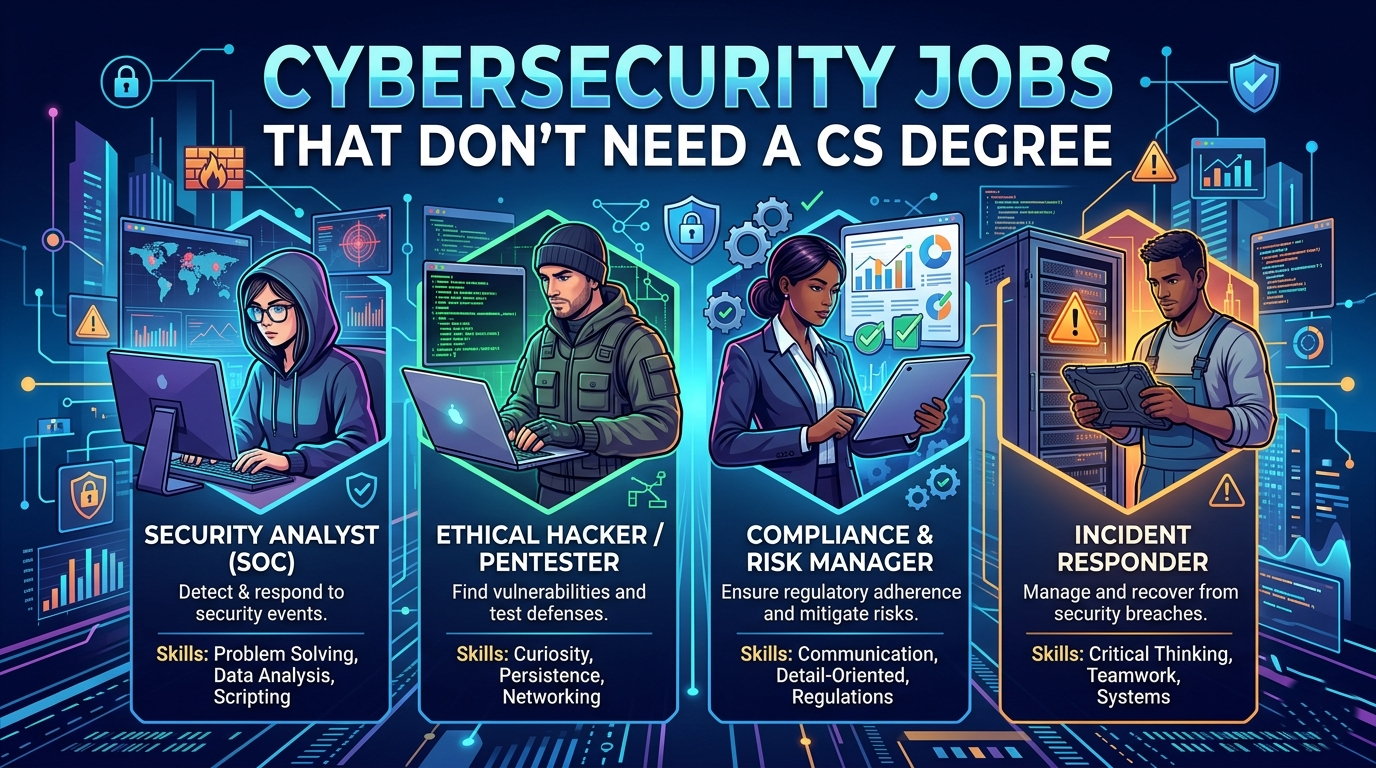
Cybersecurity Jobs That Don’t Need a CS Degree
Priya spent eight years as a paralegal. She understood risk, compliance documentation, regulatory language, and the pain of a process gone wrong. What she didn’t have was a computer science degree or any formal tech background at all.
Today she’s a GRC analyst at a healthcare technology firm, working fully remote, earning nearly double her paralegal salary.
She didn’t go back to school for four years. She didn’t learn to code. She earned one certification, leaned hard into the skills she already had, and made a lateral move that most people in her position didn’t know was available to them.
Cybersecurity has a talent crisis hiding in plain sight. There are an estimated 3.5 million unfilled cybersecurity positions globally — and the industry is slowly, sometimes reluctantly, acknowledging that a CS degree was never actually the point. Skills are the point. And skills can come from anywhere.
The Degree Myth in Cybersecurity
Let’s put this directly: the assumption that cybersecurity belongs exclusively to people who spent four years studying computer science is outdated, and the industry knows it.
A growing number of cybersecurity roles don’t require you to write code, architect networks from scratch, or understand the mathematics of cryptographic algorithms. They require clear thinking, attention to detail, strong communication, policy literacy, and the ability to understand risk human skills that translate from dozens of other professional backgrounds.
Law, psychology, journalism, military service, healthcare administration, project management, finance people from all of these fields are moving into cybersecurity careers and thriving. Not despite their backgrounds, but because of them.
The gatekeeping is real, but it’s losing ground. And if you know where to look, the doors are open.
High-Demand Cybersecurity Roles You Can Enter Without a CS Degree
Governance, Risk, and Compliance (GRC) Analyst
This is one of the most overlooked entry points into cybersecurity and one of the most accessible for career changers.
GRC analysts help organizations understand their regulatory obligations, assess their security posture, and build frameworks that keep them compliant with standards like SOC 2, ISO 27001, HIPAA, or GDPR. The work is documentation-heavy, policy-focused, and deeply reliant on structured thinking and written communication.
If you’ve ever worked in legal, audit, healthcare administration, or finance, you’re already thinking the right way for this role. Add a CompTIA Security+ or a Certified in Risk and Information Systems Control (CRISC) certification, and you have a credible case for entry.
GRC analysts working remotely can earn between $70,000 and $120,000 depending on industry and experience level.
Security Awareness Trainer
Organizations spend millions on technical security tools and then lose everything because someone clicked a phishing link. Human error remains the leading cause of data breaches. Security awareness trainers exist to fix that.
This role involves developing training programs, running phishing simulations, creating educational content, and helping employees at every level understand what secure behavior actually looks like in practice.
Background in teaching, instructional design, corporate training, human resources, or communications maps perfectly here. You don’t need to know how a firewall works at a technical level. You need to know how people learn, what makes training stick, and how to translate technical concepts into plain language.
It’s a role that’s increasingly remote-friendly and in consistent demand across enterprise organizations that take their security posture seriously.
Cybersecurity Technical Writer
Every security product, policy, incident response plan, and compliance framework needs to be written down clearly and most security professionals are not strong writers.
Technical writers in cybersecurity produce documentation for security tools, write policy frameworks, create incident response runbooks, and translate complex technical processes into language that executives, employees, and auditors can actually understand.
If you’re a strong writer with the ability to learn technical subject matter quickly, this is a legitimate entry into the cybersecurity field that pays well, is almost entirely remote, and has consistent demand across both enterprise companies and cybersecurity vendors.
Incident Response Coordinator
When a security incident happens a data breach, a ransomware attack, a system compromise someone has to manage the process. Coordinate the teams. Document what happened and when. Communicate with leadership. Ensure nothing falls through the cracks.
That person doesn’t have to be a technical expert. They have to be organized, calm under pressure, and skilled at managing moving parts simultaneously.
Project managers, operations coordinators, and former military personnel often move into incident response coordination naturally. Pair your organizational background with a CompTIA CySA+ or an EC-Council Certified Incident Handler credential, and you’ve made yourself a competitive candidate.
Cybersecurity Sales Engineer and Pre-Sales Consultant
This one surprises people, but it makes complete sense. Cybersecurity companies need people who can talk to potential customers — understand their problems, explain how a product addresses their specific environment, and build trust through credibility.
Pre-sales consultants and sales engineers in cybersecurity don’t write the tools. They explain them. The best people in these roles combine communication skills, the ability to learn product deeply, and enough technical literacy to hold a real conversation with a CISO.
Compensation for these roles is frequently among the highest in the industry base salaries often starting at $90,000, with on-target earnings (including commission) regularly exceeding $150,000.
Threat Intelligence Analyst
Threat intelligence is about understanding who the adversaries are, what they’re after, and how they operate. It draws as much from geopolitics, journalism, and behavioral analysis as it does from technical knowledge.
Former intelligence analysts, journalists, researchers, and policy professionals have genuine advantages here. The ability to synthesize large amounts of information, identify patterns, assess credibility of sources, and communicate findings clearly — these are the core competencies. Technical depth is learnable over time.
How to Actually Break In: Actionable Steps
Start with a foundational certification. CompTIA Security+ is the industry-standard entry credential and doesn’t require prior tech experience. It signals baseline literacy and opens doors. Budget roughly $350 for the exam and 2–3 months of self-study.
Build in public. Start a blog, a LinkedIn newsletter, or even a thread series where you document your learning journey. People who demonstrate thinking in public attract opportunities that passive job applicants don’t.
Map your existing skills to cybersecurity language. A background in healthcare administration? That’s HIPAA compliance experience. Legal background? That’s contract risk and regulatory framework fluency. Reframe your résumé before you rewrite it.
Find a community before you need it. The cybersecurity community is genuinely generous with career advice, especially toward career changers. Communities like SANS CyberTalent, Women in CyberSecurity (WiCyS), and various Discord servers provide mentorship, job leads, and honest guidance.
Target the right employers first. Cybersecurity vendors (the companies building security tools) often have more entry-level and non-technical roles than enterprise security teams. Managed Security Service Providers (MSSPs) also hire frequently for roles that don’t demand deep technical backgrounds.
Consider a cybersecurity bootcamp strategically. Some are genuinely useful — particularly those with job placement support and industry-recognized curriculum. Others are expensive and undersupported. Research outcomes data, not just marketing promises, before you invest.
The Remote Dimension Makes This Even More Compelling
Cybersecurity is among the most remote-friendly sectors in tech. Digital infrastructure doesn’t require physical proximity. Policy work happens on documents. Training happens on video. Threat intelligence is entirely online. Compliance frameworks live in cloud platforms.
A GRC analyst in Manila can serve a fintech company in Amsterdam. A security awareness trainer in Lagos can run programs for a US healthcare network. The geography has genuinely dissolved for a significant portion of these roles — and salaries in the space have held up globally because the demand-supply gap remains severe.
For career changers in regions with lower local wage ceilings, the international reach of remote cybersecurity work is particularly significant. You’re not competing for local roles at local rates. You’re competing globally, with skills that transfer.
Cybersecurity doesn’t belong to people with CS degrees. It never really did the industry just took a while to figure that out. What it belongs to is people who think clearly about risk, communicate well, stay curious, and show up consistently.
The roles are real. The demand is real. The pay is real. And the entry points for people without traditional tech backgrounds are more accessible today than they’ve ever been.
You don’t need to go back to school. You need a plan, one good certification, and the willingness to make your first move.
Ready to break into cybersecurity on your terms? Start with the role that maps closest to your current background, find the right certification to complement it, and make your first public move this week. The industry is hiring — and it doesn’t care where your degree is from.
Frequently Asked Questions
Can I really get a cybersecurity job without a computer science degree? Yes and increasingly, employers are actively seeking it. Many high-demand cybersecurity roles, particularly in GRC, security awareness, technical writing, and threat intelligence, require critical thinking, communication, and domain expertise more than coding ability. Certifications like CompTIA Security+, CRISC, and CISSP carry significant weight and are specifically designed to validate competency without requiring a four-year CS degree.
What’s the fastest way to get into cybersecurity without experience? The most direct path for most career changers is to identify which cybersecurity domain maps to their existing background, earn one relevant certification, and apply to vendor-side or MSSP roles where entry-level hiring is more consistent. Supplementing with home labs, CTF (Capture the Flag) competitions for technical roles, or portfolio projects like policy framework samples for GRC roles accelerates the process. Realistic timeline for a first role: 6–12 months of focused preparation.
Which cybersecurity certifications are worth it for beginners? CompTIA Security+ is the most universally recognized starting point and is often required or preferred for government-adjacent cybersecurity roles. For GRC specifically, CompTIA’s new SecurityX or the CRISC certification adds significant credibility. Google’s Cybersecurity Certificate on Coursera is a lower-cost entry point worth considering for complete beginners. Avoid certifications from vendors you’ve never heard of — research pass rates, employer recognition, and community reputation first.
How much do entry-level remote cybersecurity jobs pay? Entry-level cybersecurity roles for non-technical positions typically start between $55,000 and $75,000 in US-equivalent markets, with GRC and compliance analyst roles often starting higher due to the regulatory knowledge premium. Technical roles like junior SOC analyst tend to start in the $60,000–$85,000 range. With 2–3 years of experience and a second certification, crossing $100,000 is realistic in most of these paths.
Is cybersecurity a good career for career changers over 40? Absolutely — and in many cases, it’s an advantage. Career changers over 40 bring professional maturity, industry domain knowledge, and communication skills that new CS graduates often lack. A former nurse who moves into healthcare cybersecurity compliance brings clinical context that no bootcamp can teach. A former banker entering financial services security brings regulatory and risk credibility from day one. The industry needs both technical depth and real-world domain expertise — and experienced career changers can offer the latter immediately.