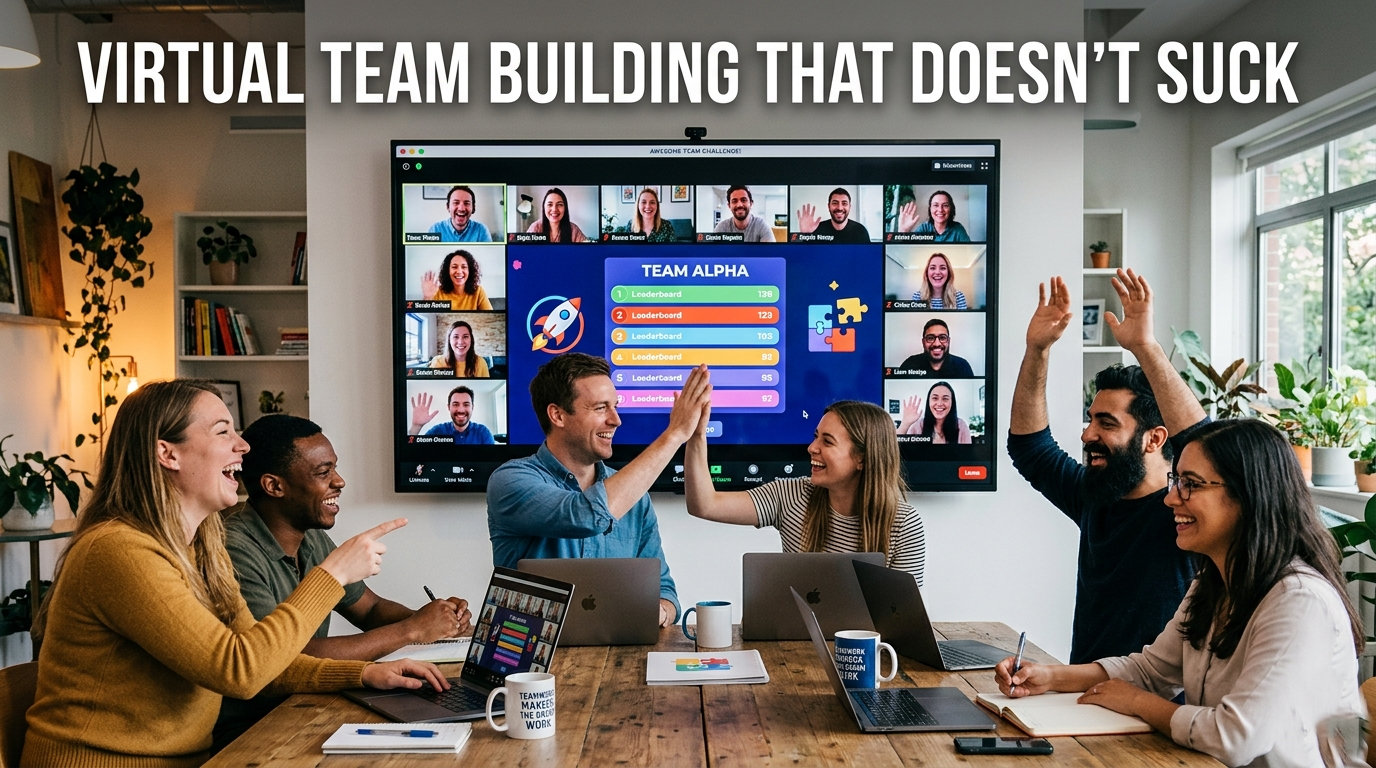
Virtual Team Building That Doesn’t Suck
You’ve been there. It’s 5 PM on a Friday. The calendar invite says “Team Happy Hour 🎉” and your stomach does a small, tired sigh. You log in, someone asks “so… how’s everyone doing?” and the next 45 minutes is a slow-motion exercise in performative fun.
Virtual team building has a reputation problem and honestly, it earned it.
But here’s the thing: the problem was never remote work itself. It was the assumption that digitizing the office happy hour would somehow replicate the organic connection that happens when people share physical space. It doesn’t. And pretending otherwise is how you end up with a team that dreads its own calendar.
Real connection on remote teams is possible. It just requires thinking completely differently about what “team building” actually means.
Why Most Virtual Team Building Fails
Let’s name the real issue before we fix it.
Most virtual team building activities fail because they’re designed around presence, not participation. They put people in a room (digital or otherwise) and hope chemistry happens. But chemistry doesn’t happen on command especially not on a screen, especially not at the end of a workday, and especially not when attendance is technically optional but professionally mandatory.
The other problem? Most activities are entirely divorced from who these people actually are. A trivia night sounds fun in theory. But if half your team is spread across six time zones, the other half is juggling kids at 8 PM, and nobody particularly enjoys trivia, you’ve planned an event that’s less about connection and more about saying you tried.
Effective virtual team building starts with understanding your actual team their schedules, their interests, their communication styles — and working from there.
What Actually Creates Connection in Remote Teams
Shared Experience Over Shared Screen Time
There’s a meaningful difference between being on a call together and actually doing something together. Passive participation — sitting on a video call while someone talks doesn’t build bonds. Collaborative participation does.
When people work toward something together, even something small and low-stakes, they form memories. Memories become stories. Stories become the fabric of team culture.
This is why cooking classes over Zoom (where everyone actually cooks simultaneously) tend to land better than virtual wine tastings where people just… drink and chat. One involves shared effort and real-time problem-solving. The other is just a video call with beverages.
Consistency Over Spectacle
One meaningful five-minute team ritual every single week does more for team cohesion than one elaborate quarterly event.
Think about how friendships form in real life. Not through grand gestures through repeated, low-pressure contact over time. The same principle applies to remote teams. Regular touchpoints that feel lightweight and genuine will outlast any team offsite in terms of lasting cultural impact.
Some of the strongest remote teams run what they call “connection rituals” brief, consistent moments built into the weekly rhythm. A Monday check-in where everyone shares one non-work thing they’re looking forward to. A Friday wins thread in Slack. A “hot take” channel where people post opinions on anything from coffee to code architecture.
None of these require scheduling. None require a facilitator. They just require intentionality.
Psychological Safety First
Here’s what nobody puts in the team building listicles: none of this works if people don’t feel psychologically safe.
If team members are worried about how they’ll be perceived, if there’s unresolved conflict, if certain people dominate every conversation — no amount of virtual escape rooms will fix that. Before you plan a single activity, ask yourself whether the conditions for genuine connection actually exist on your team.
Sometimes the most important team building work is having hard conversations, giving people more autonomy, or simply listening better in 1:1s.
Virtual Team Building Ideas That People Actually Enjoy
Skill Swaps
Ask team members to teach each other something they know that has nothing to do with work. One person teaches the basics of fermentation. Another walks the team through beginner origami. Someone else gives a 10-minute intro to their hometown’s history.
These sessions are short (20–30 minutes max), casual, and genuinely revealing. You learn things about colleagues you’d never discover in a project kickoff. And the person teaching gets a moment to be seen as more than their job title.
Async Team Challenges
Not everything needs to be synchronous. An async photo challenge everyone submits a photo based on a weekly theme like “something broken,” “my morning,” or “what’s outside your window” builds connection without requiring anyone to show up live at a specific time.
Compile the photos in a shared doc or Slack channel, let people comment and react, and watch the conversations that follow. It’s low friction, surprisingly personal, and works across every time zone.
Collaborative Playlists
Create a shared Spotify playlist and let everyone add songs. No rules, no theme. Just add what you’re listening to this week.
It sounds almost too simple. But it works. Music is personal in a way that spreadsheets and Slack messages aren’t. A team playlist becomes a window into who people actually are and a surprisingly reliable conversation starter.
Virtual Co-Working Sessions
For remote workers who miss the ambient energy of shared space, structured co-working sessions can be genuinely valuable. Everyone joins a video call, states what they’re working on, mutes, works for 45–50 minutes, then comes back for a brief check-out.
No agenda. No facilitation. Just the quiet companionship of working alongside other humans. For deep-focus workers and introverts especially, this format often lands far better than activity-based team building.
Interest-Based Channels and Clusters
Stop forcing the whole team into a single social experience. Instead, let people self-select into groups based on actual shared interests.
A #books channel. A #parenting channel. A #film-club channel. A #side-projects channel. Let conversations happen organically between the people who actually want to have them.
This approach respects that a 35-person team is not a monolith. It doesn’t have one culture it has subcultures. Nurture those.
Practical Tips for Running Better Virtual Team Building
- Ask your team what they actually want. A simple anonymous survey beats 10 hours of planning for an event nobody asked for.
- Default to shorter. A 20-minute activity that’s well-designed will generate more energy than a 90-minute event that drags.
- Rotate facilitation. Let different team members lead different activities. It distributes voice and surfaces people who might otherwise stay quiet.
- Never force cameras. Camera-on mandates create anxiety, not connection. Trust people to show up how they’re comfortable.
- Debrief afterward. A quick Slack message — “what landed, what didn’t?” — is all you need. Treat virtual team building like a product you’re iterating on.
- Celebrate real milestones. Promotions, work anniversaries, personal wins, project completions — marking these publicly matters more than most leaders realize.
The Remote-First Companies Getting This Right
GitLab, Automattic, and Doist are frequently cited as remote-first companies with genuinely strong cultures — and none of them built those cultures through mandatory Zoom happy hours.
What they share is a commitment to async-first communication, thoughtful documentation of values, and consistent investment in the kind of low-pressure, high-frequency touchpoints that build real familiarity over time. They also invest in in-person meetups when possible recognizing that periodic face-to-face time can do in two days what months of virtual touchpoints struggle to replicate.
The hybrid approach strong remote culture punctuated by intentional in-person moments is increasingly where the smartest distributed teams are landing.
Virtual team building doesn’t have to be the thing people groan about on Friday afternoons. But making it better requires letting go of the idea that you can replicate office culture on a screen.
The remote teams with the strongest cultures aren’t the ones running the most activities. They’re the ones who’ve been the most intentional about consistency, about inclusion, about actually listening to what their people need.
Start small. Ask your team one genuine question: what would make you feel more connected to the people you work with? Then build from that answer, not from a listicle.
Want to build a remote team that actually wants to show up? Start by redesigning your next team touchpoint around participation over presence and see what happens.
Frequently Asked Questions
What is virtual team building and why does it matter? Virtual team building refers to intentional activities and practices designed to build trust, connection, and culture among remote or distributed team members. It matters because remote workers who feel genuinely connected to their team report higher engagement, lower burnout, and stronger job satisfaction all of which directly impact retention and performance.
How often should remote teams do team building activities? More frequently than most teams do, but less elaborately. Short, consistent touchpoints weekly or biweekly tend to outperform infrequent large-scale events. Aim for lightweight rituals that fit naturally into your team’s existing rhythm rather than scheduled events that feel like interruptions.
What are the best virtual team building activities for large remote teams? For larger teams (20+ people), async formats work best because they remove the time-zone and scheduling barrier. Options include async photo challenges, collaborative playlists, interest-based Slack channels, skill swap recordings, and anonymous team surveys. Live sessions work better in smaller subgroups of 4–8 people rather than whole-company calls.
How do you build team culture when everyone works in different time zones? Prioritize documentation and async communication as cultural carriers. A well-written team handbook, public Slack channels with active conversation, regular written updates from leadership, and async video tools like Loom help culture spread without requiring everyone to be online at the same time. Supplement with rotating live sessions that alternate timing to be fair across time zones.
What’s the difference between team building and team bonding? Team building typically involves structured activities aimed at improving specific dynamics communication, collaboration, problem-solving. Team bonding is more organic the casual, unstructured connection that happens when people get to know each other as humans, not just colleagues. Both matter for remote teams, but most companies over-invest in structured team building and underinvest in the conditions that let natural bonding happen.